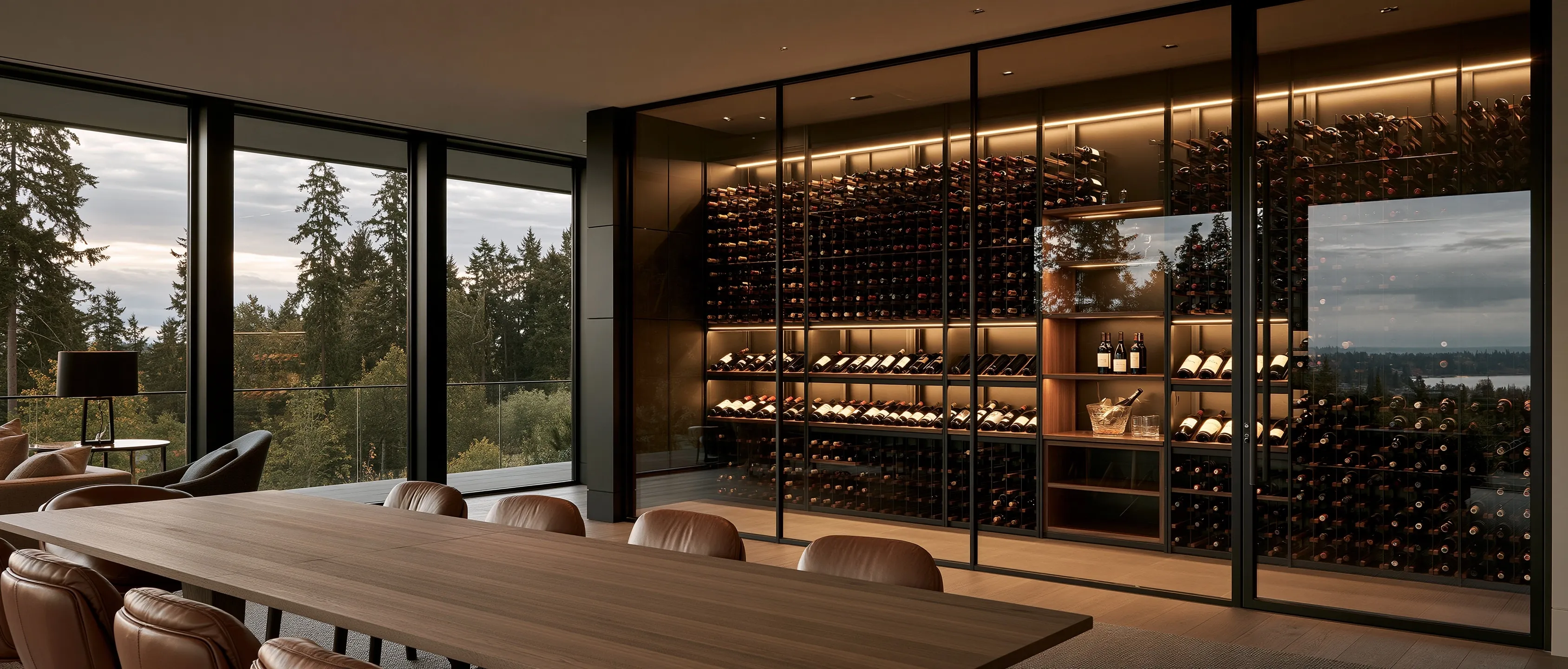
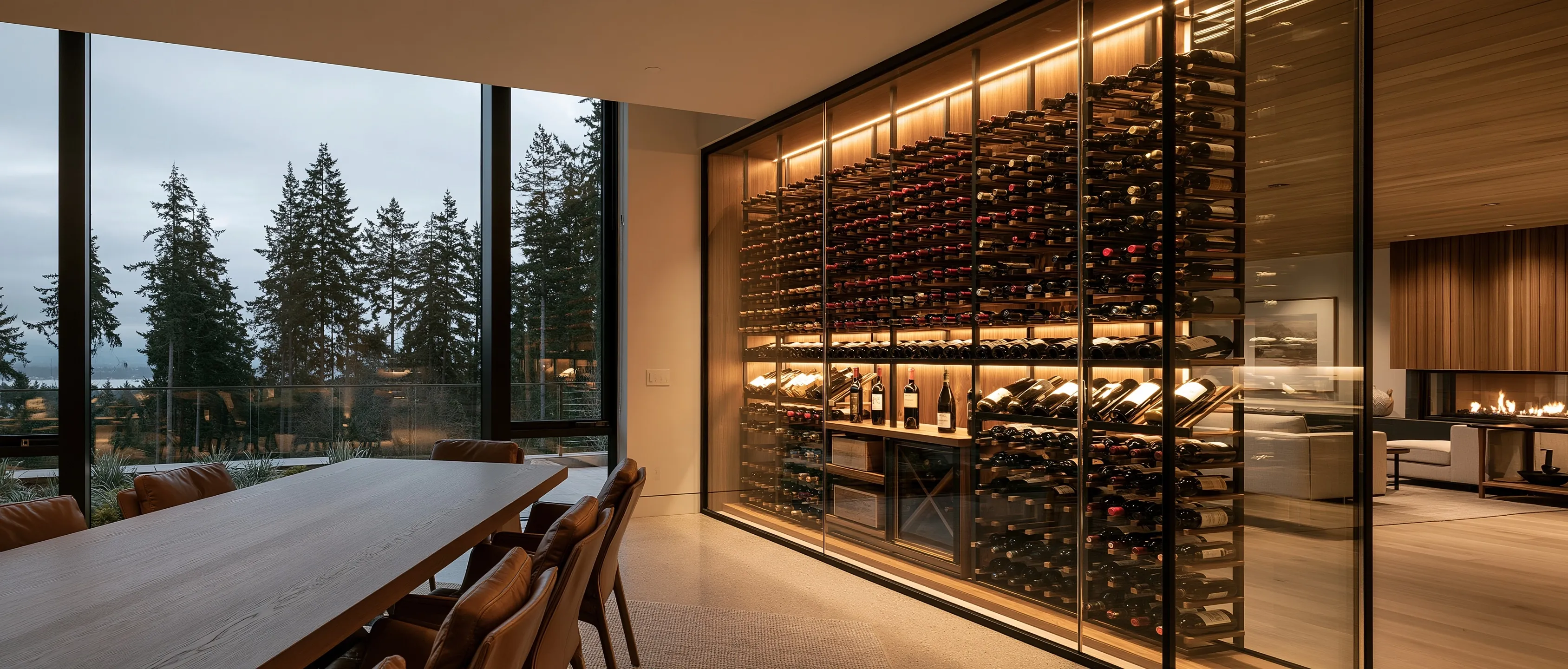
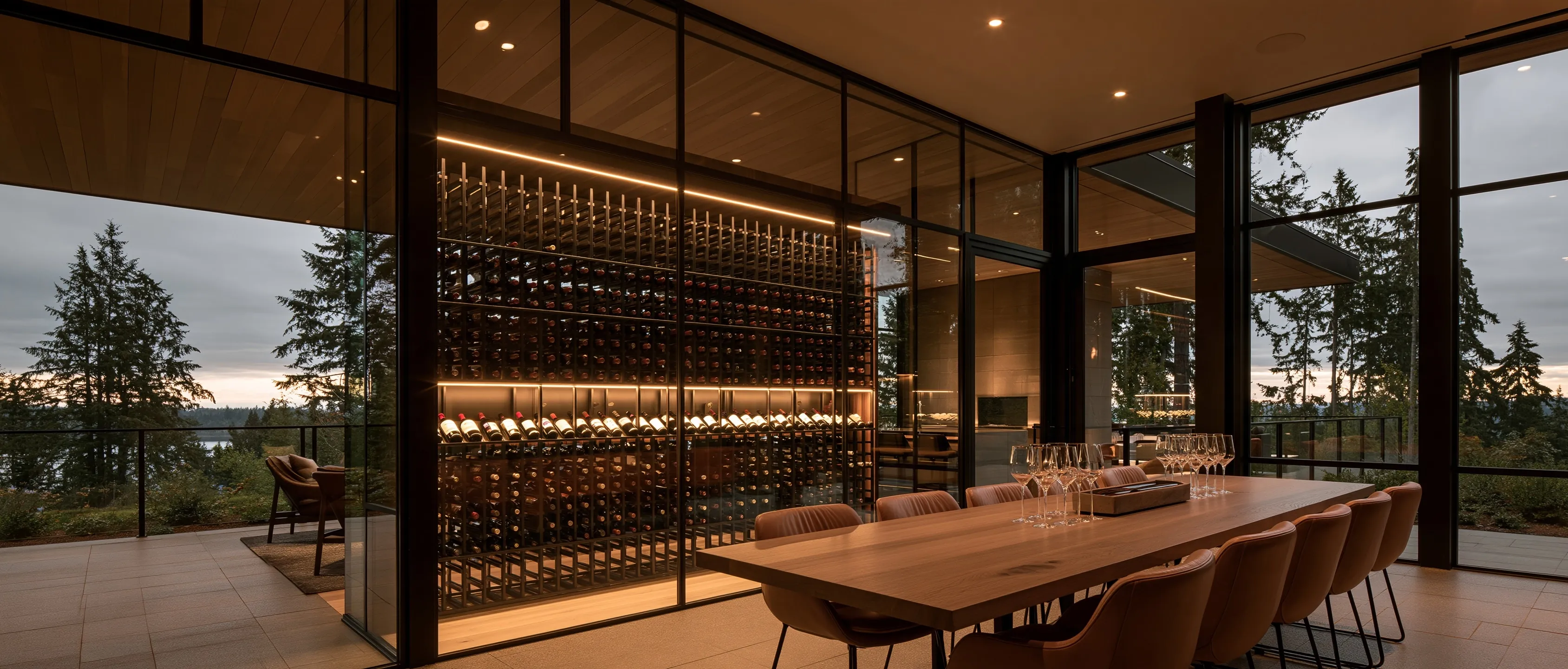
Glass-walled wine room with lit bottle racks beside a long dining table, evergreens and a lake view through floor-to-ceiling windows

Custom wine cellars · Bellevue, Washington

Bellevue Wine Cellars: Custom Wine Cellars and Wine Rooms

Request a wine cellar quoteSee the cellar types

Bellevue Wine Cellars approaches every custom wine cellar, glass wine room and wine wall it builds for a Bellevue home as engineering first and furniture second. Insulated walls and ceiling, an air-sealed shell with vapor control, an exterior-grade door and a cooling unit sized to that shell are what let a room hold close to 55°F, the figure Purdue Extension calls traditional for cellars, with humidity kept moderate and the temperature barely moving.

Nearly half of Bellevue’s housing was built before 1980, and about a third of all units date from the 1960s and 1970s, so a glass room or walk-in cellar can be folded into a main-floor remodel instead of waiting for a basement. Summers here are mild and winters damp, which makes the shell and its vapor control matter more than raw cooling power. Browse the wine cellar gallery for directions to start from.

What every plan covers

Custom wine cellars and wine rooms

Rooms you can walk into or look into: a dedicated walk-in, a glazed room off the main living space, a lower-level conversion, or a cooled wall where floor space is better left open. Each is built around the same insulated, sealed and cooled shell.

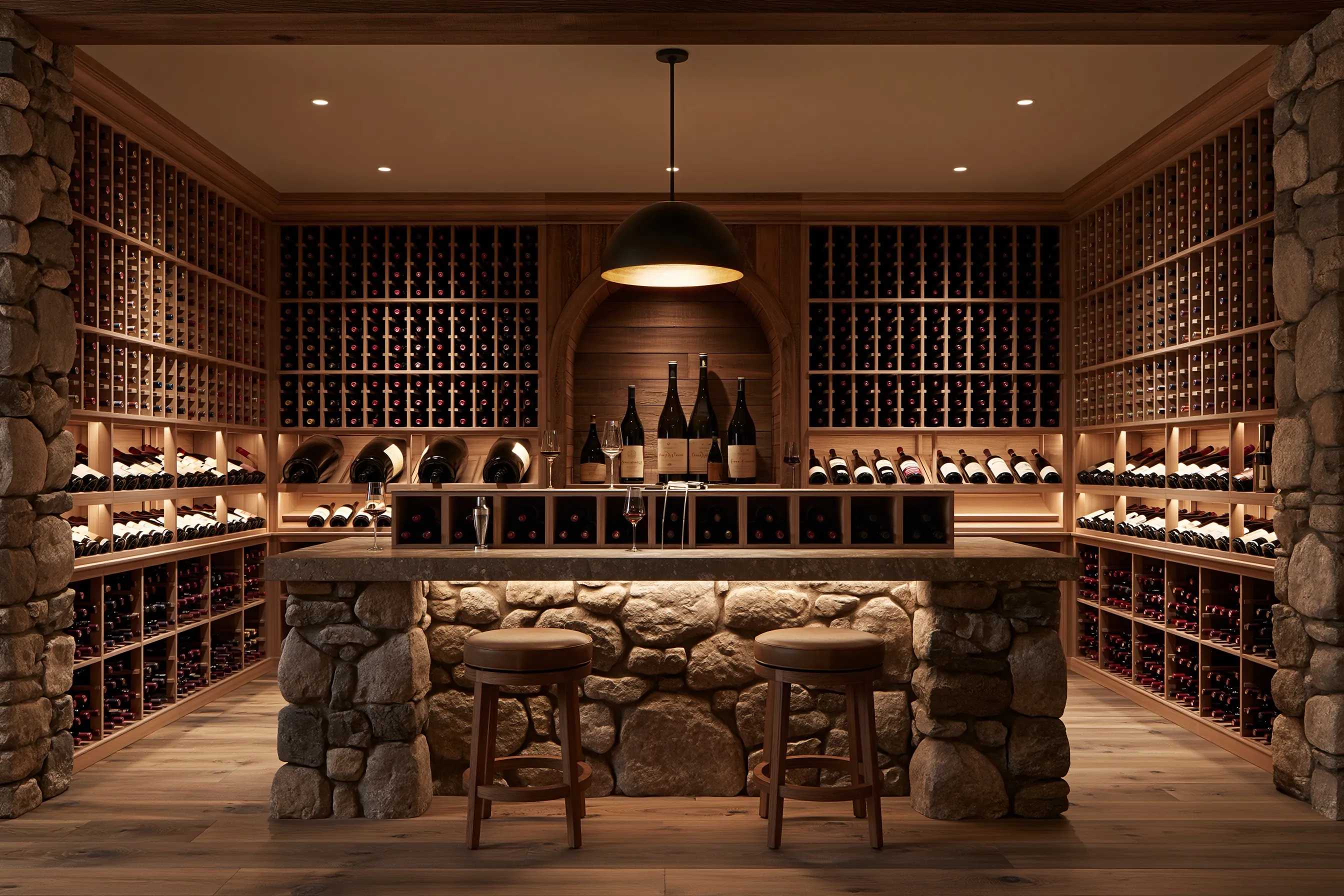
Walk-in cellar with wood racking on three walls, large bottles in a central niche and a stone-faced tasting counter with two stools

Walk-in custom wine cellars

Turning a spare bedroom, bonus room or slice of a lower floor into a walk-in starts with treating it as a refrigerated box. We rebuild the walls and ceiling with insulation, wrap the warm side in unbroken vapor control, seal each outlet, switch and seam, and hang an exterior-grade door. The cooling unit and racks come last, since their sizing hinges on how airtight that enclosure ends up.
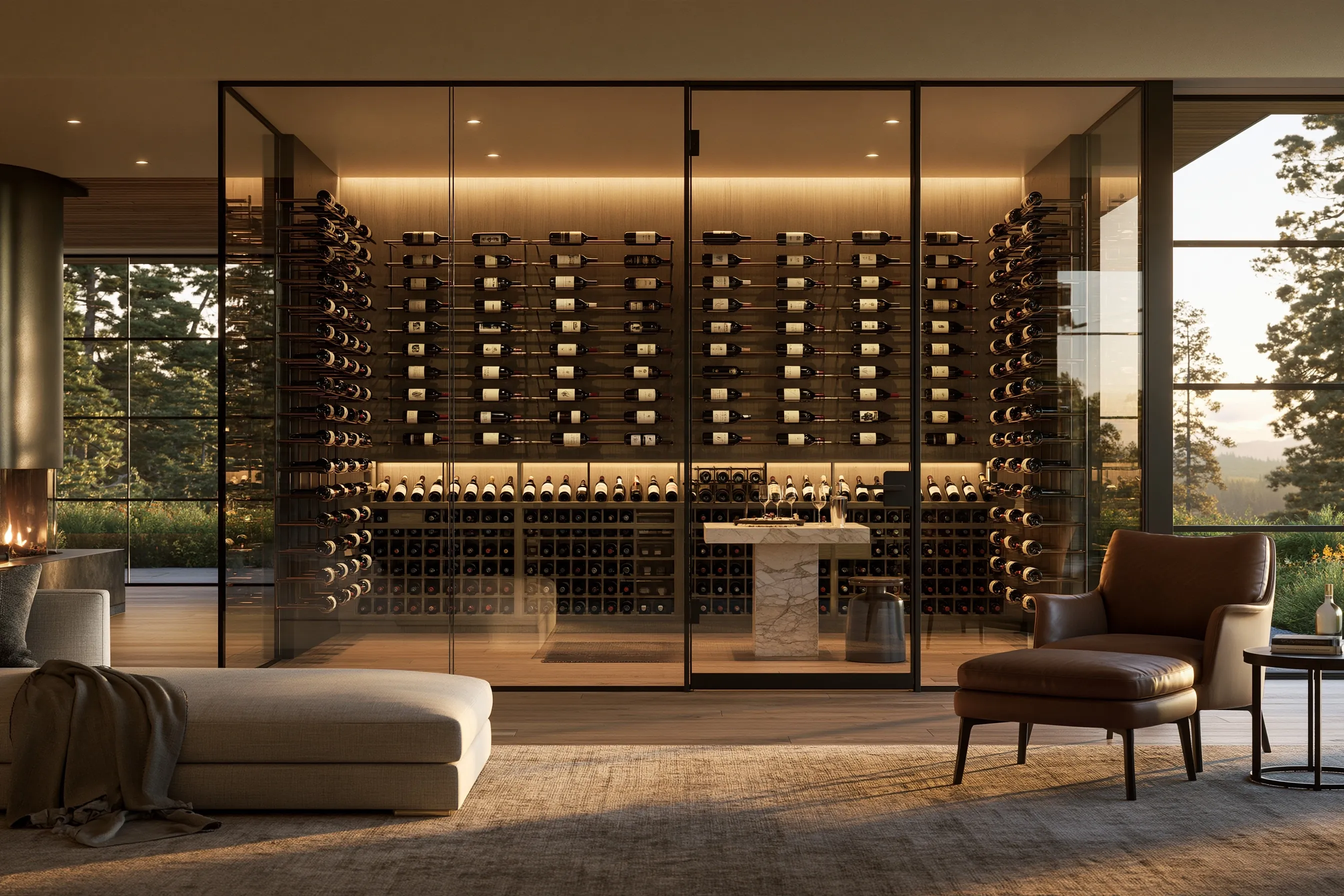
Slim black-framed glass wine room with label-forward metal racks and a marble tasting table, opening off a living room with a leather armchair

Glass wine rooms

A glass wine room puts the collection in view of the dining or living area, glazed on the faces people see. The ceiling, back wall and floor are still insulated like any cellar, while the glass itself is specified as insulated double panes so it adds less heat and is less prone to fogging. Because even good glass lets in more heat than an insulated wall, the cooling is sized with the glazing counted in.

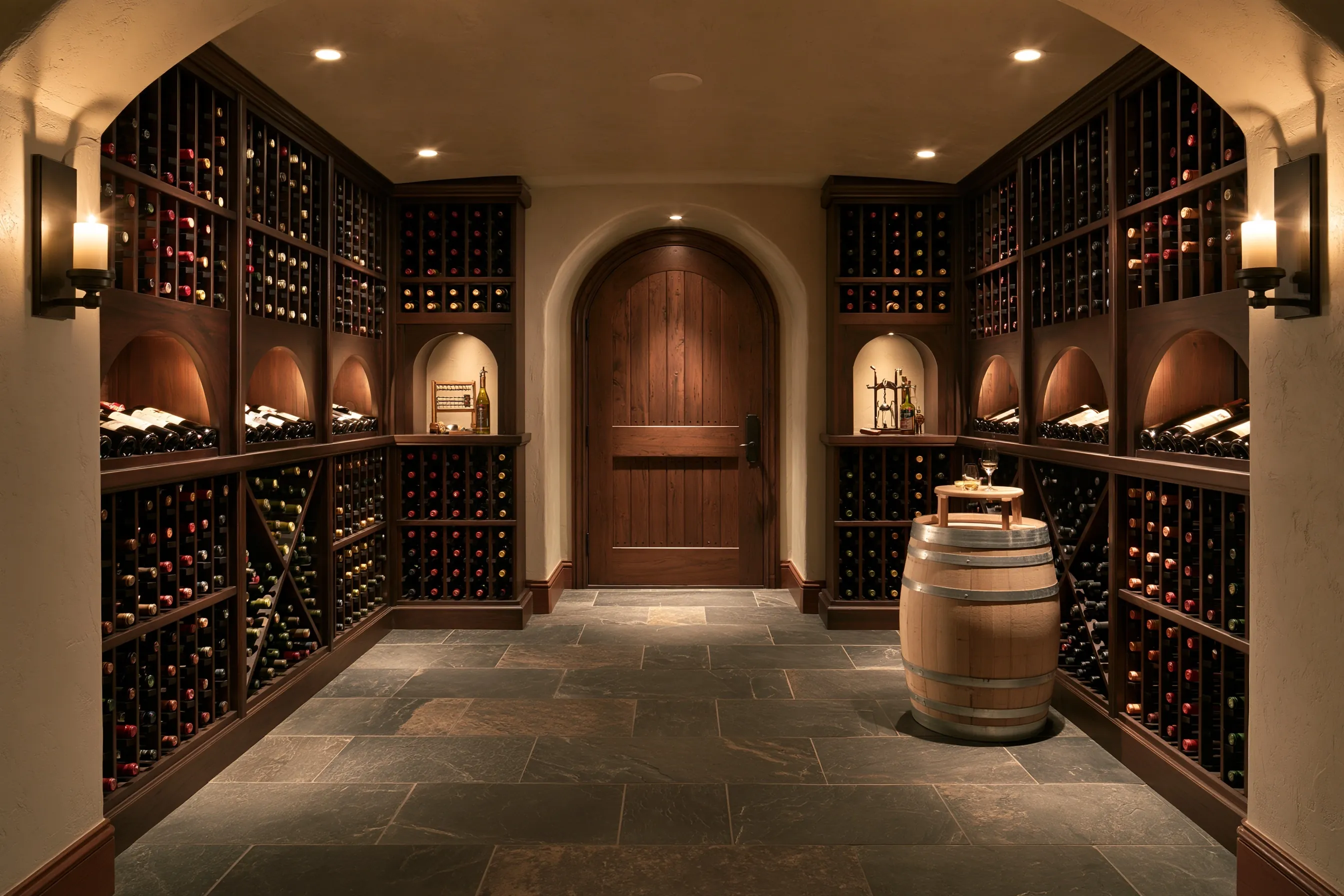
Lower-level walk-in cellar with arched niches, dark wood racks, a slate floor, an oak barrel and an arched plank door

Basement wine cellars

Below grade, the first job is confirming the foundation stays dry, since a cellar wall should never trap seepage behind it. Framing stands off the concrete by at least an inch, the slab’s heat load goes into the cooling calculation, and the floor gets a sealer before any wood or stone finish where there is no vapor barrier beneath it. In a partial or daylight basement, the walls that face outside need extra insulation.

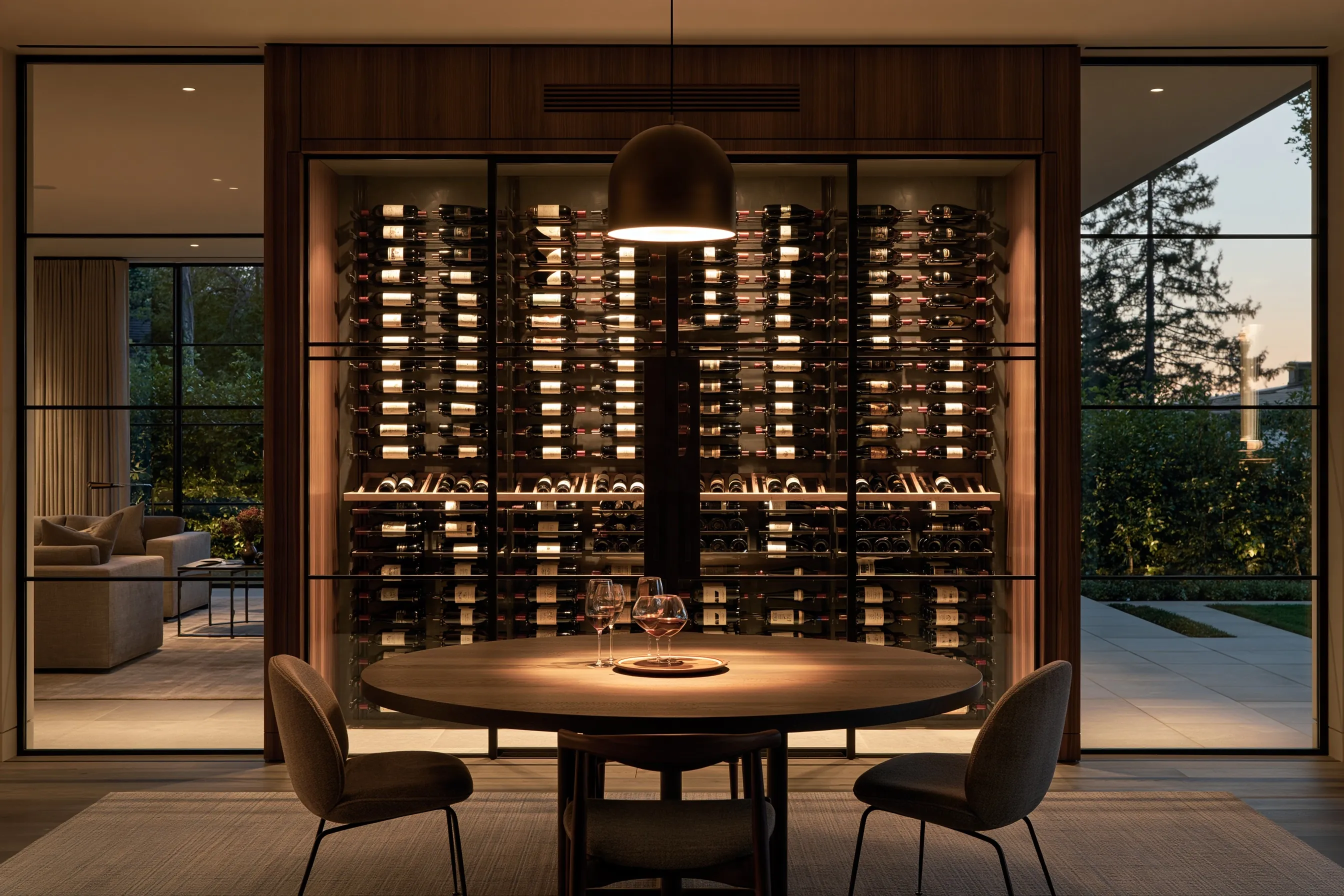
Glass-fronted wine wall with metal peg racking in a walnut surround, behind a round dining table under a pendant lamp

Custom wine walls

Where there is no room to give up, a wine wall stores bottles in a shallow reach-in cabinet behind insulated glass doors, built into kitchen or dining-room millwork. It is cooled like a miniature cellar, so the plan has to find a quiet place for the condenser and its warm exhaust, along with a dedicated circuit and a condensate drain.

Compact wine cellars and cellar cooling

Smaller footprints put more weight on one question: where the cooling unit’s warm exhaust can go. These options cover the space under a stair, a converted closet and the equipment choices themselves.

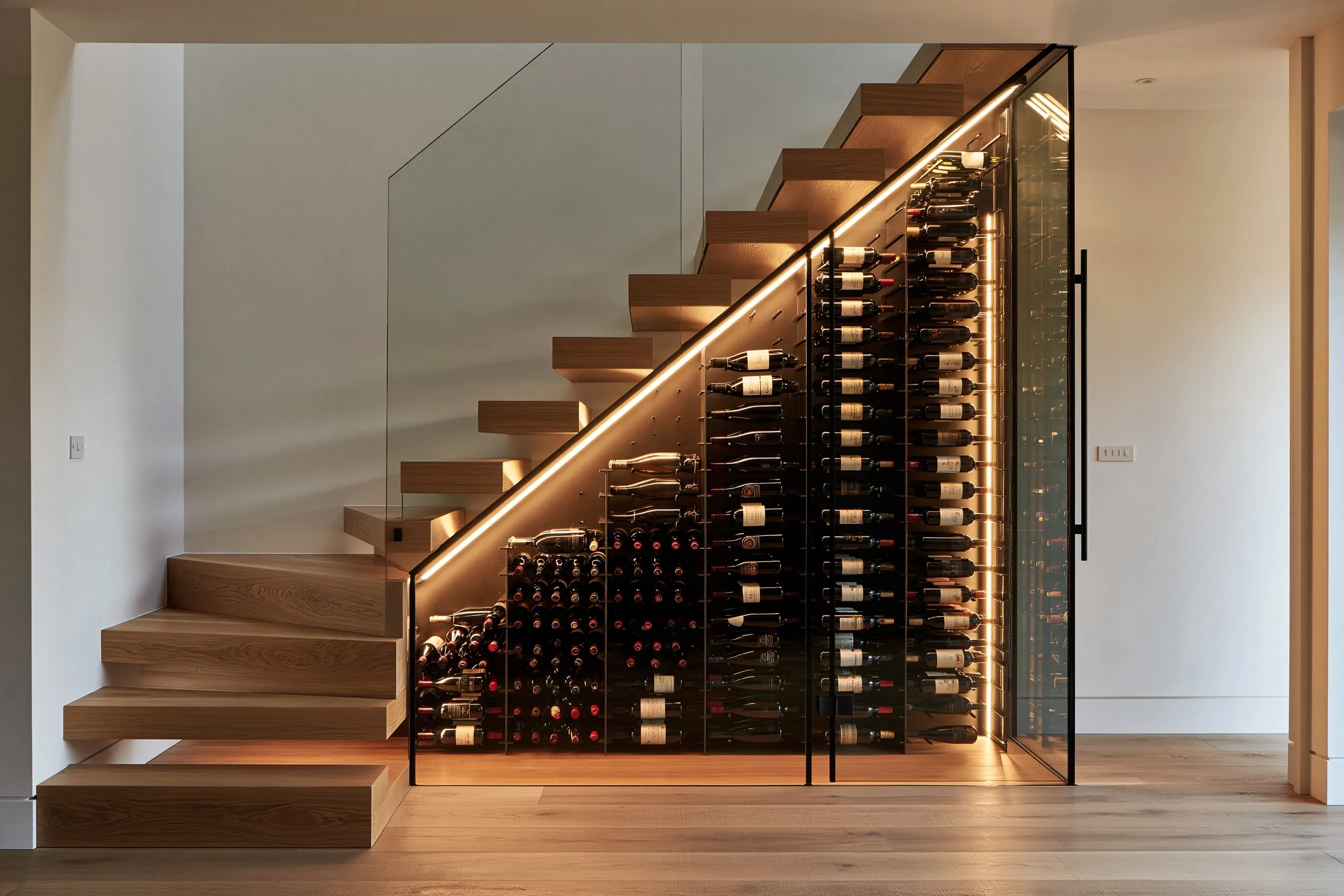
Glass-enclosed wine cellar under a floating oak staircase, lit by an LED strip that follows the stair line

Under-stair wine cellars

The triangle under a staircase holds more bottles than it looks, provided the racking steps down with the slope. The stair underside is insulated and sealed like any ceiling, open risers are closed off, and a glass face or door turns the void into a display. The harder question is where the cooling unit’s heat can go.

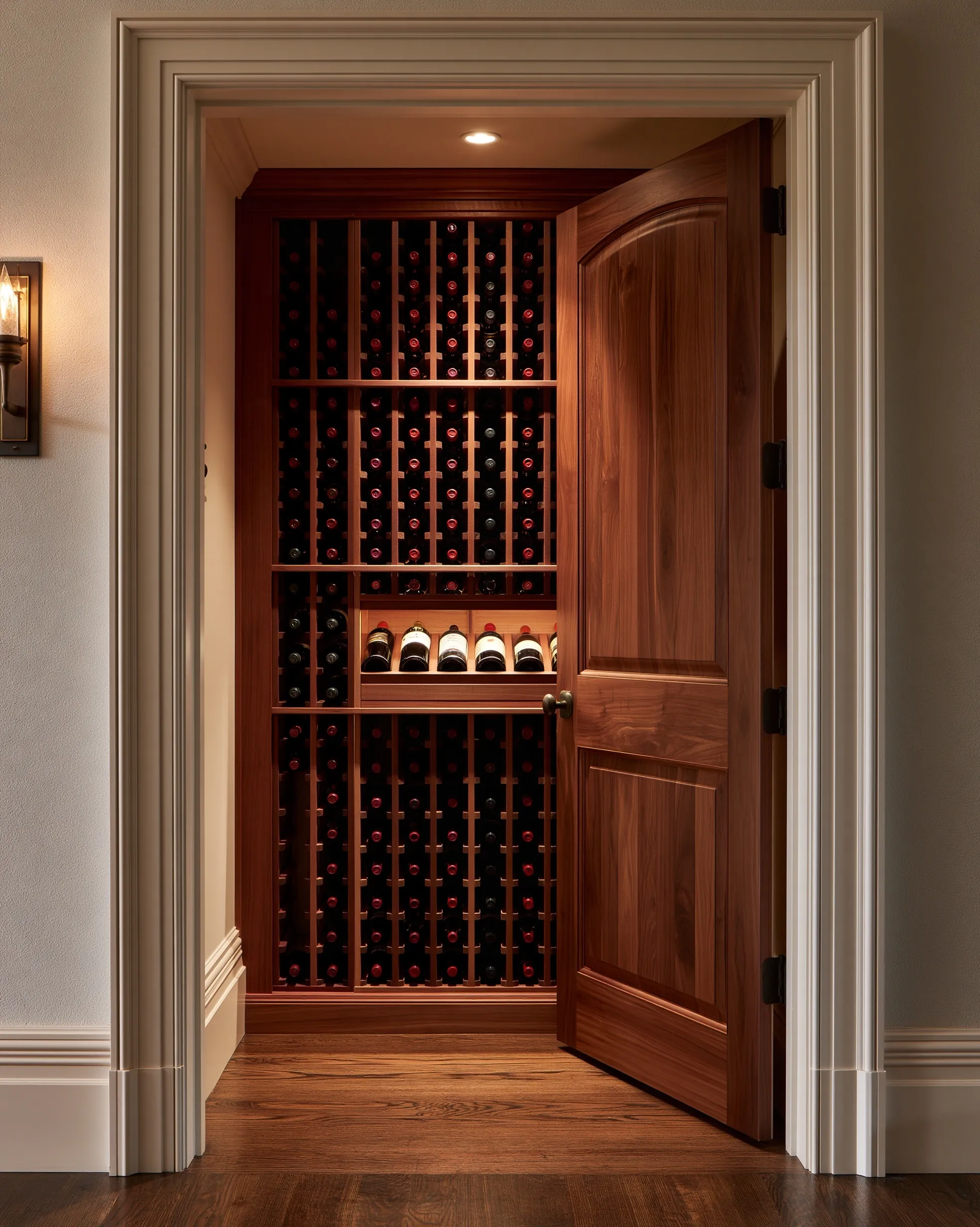
Reach-in closet lined with reddish wood bottle racks behind an open raised-panel wood door

Closet wine cellar conversions

Converting a closet means swapping its hollow door for an insulated exterior-grade door sealed on all four sides, then insulating, vapor-sealing and racking the space front to back. Through-wall units cannot dump heat into another closet, so the cooling vents to a large room nearby or goes ducted.

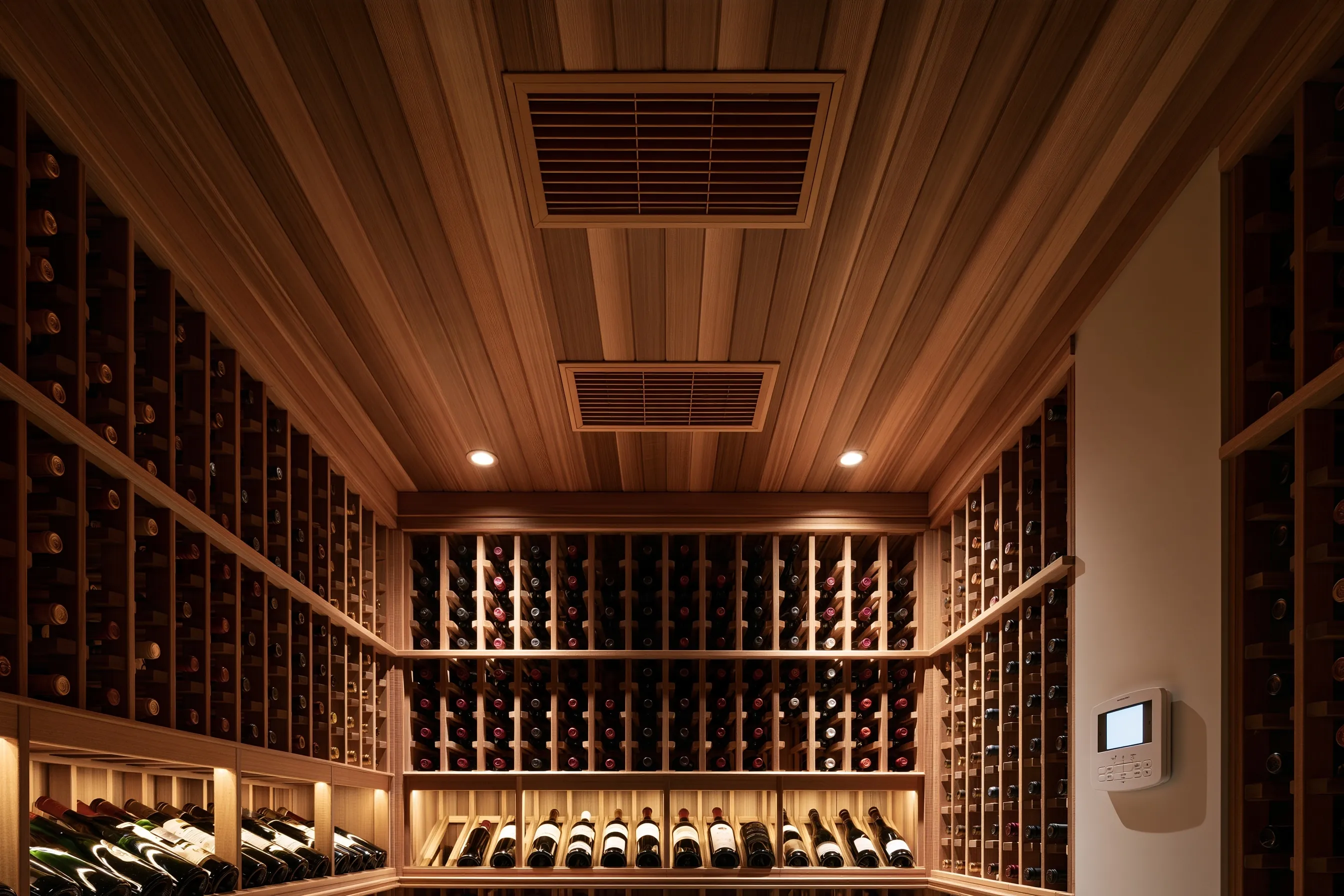
Wood-lined walk-in cellar with two ceiling grilles for ducted cooling, racking on three walls and a wall-mounted controller

Wine cellar cooling systems

We select and install through-wall, ducted and split cellar systems, new or as replacements. The choice comes down to where the warm exhaust can go, how large and warm that space gets, and how much quiet the cellar needs. Split systems involve refrigerant line sets and certified handling.

Racks, cellar doors and lighting for wine rooms

The finishing pieces decide how a cellar looks and how well it holds temperature: what the bottles rest on, how the door seals, and how the room is lit without warming it.

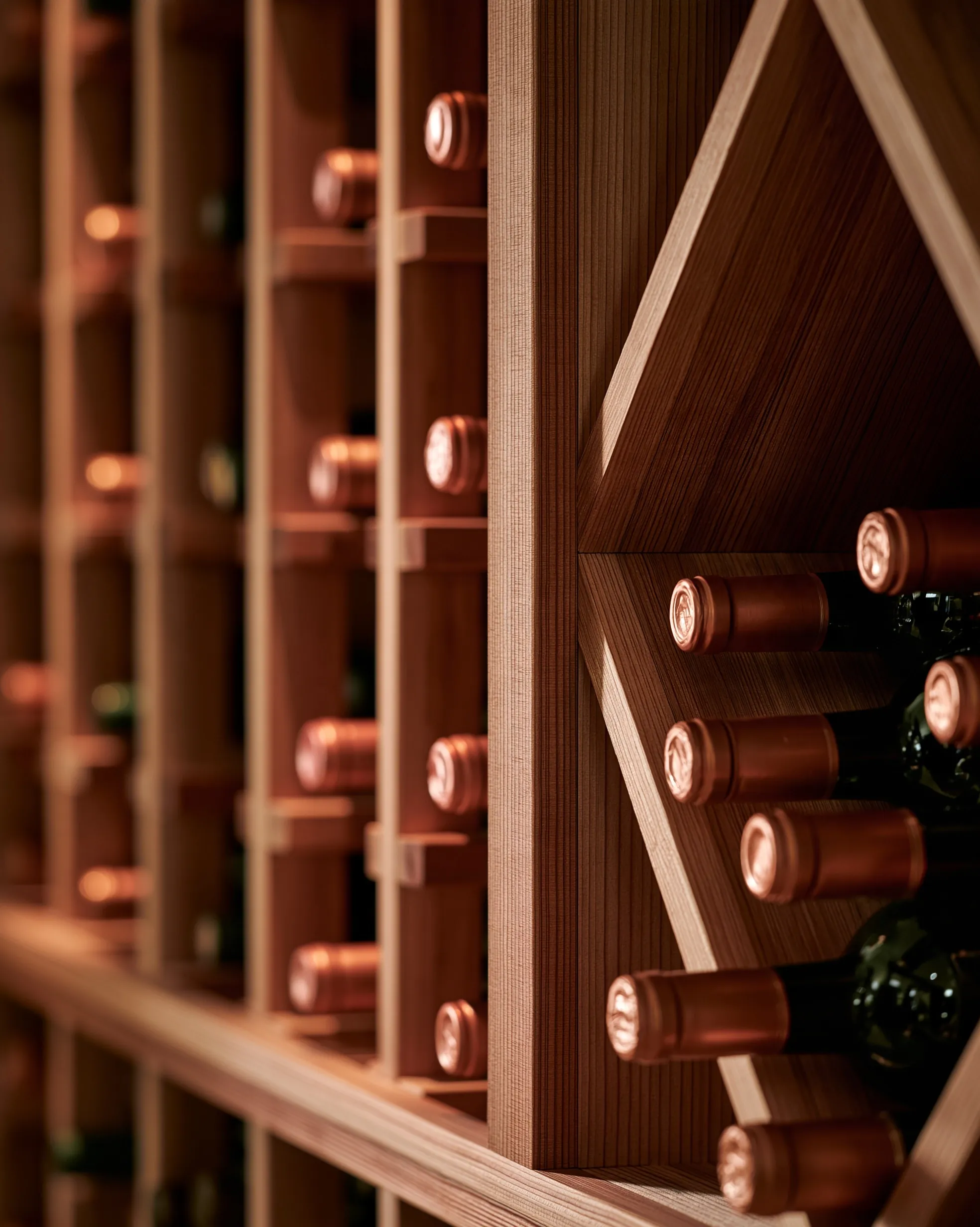
Close view of light wood individual bottle slots beside a diamond bin stacked with bottles

Custom wine racking

Wood for racks is picked for how it behaves in cool, humid air and whether it smells. According to Wine Enthusiast, redwood heartwood holds up against rot and mildew and mahogany against warping; pine is less stable, and both pine and cedar can carry odors. Any stain is water-based. A layout can combine single slots, diamond bins for whole cases and label-forward rows for show, with spaces sized for magnums and Champagne.

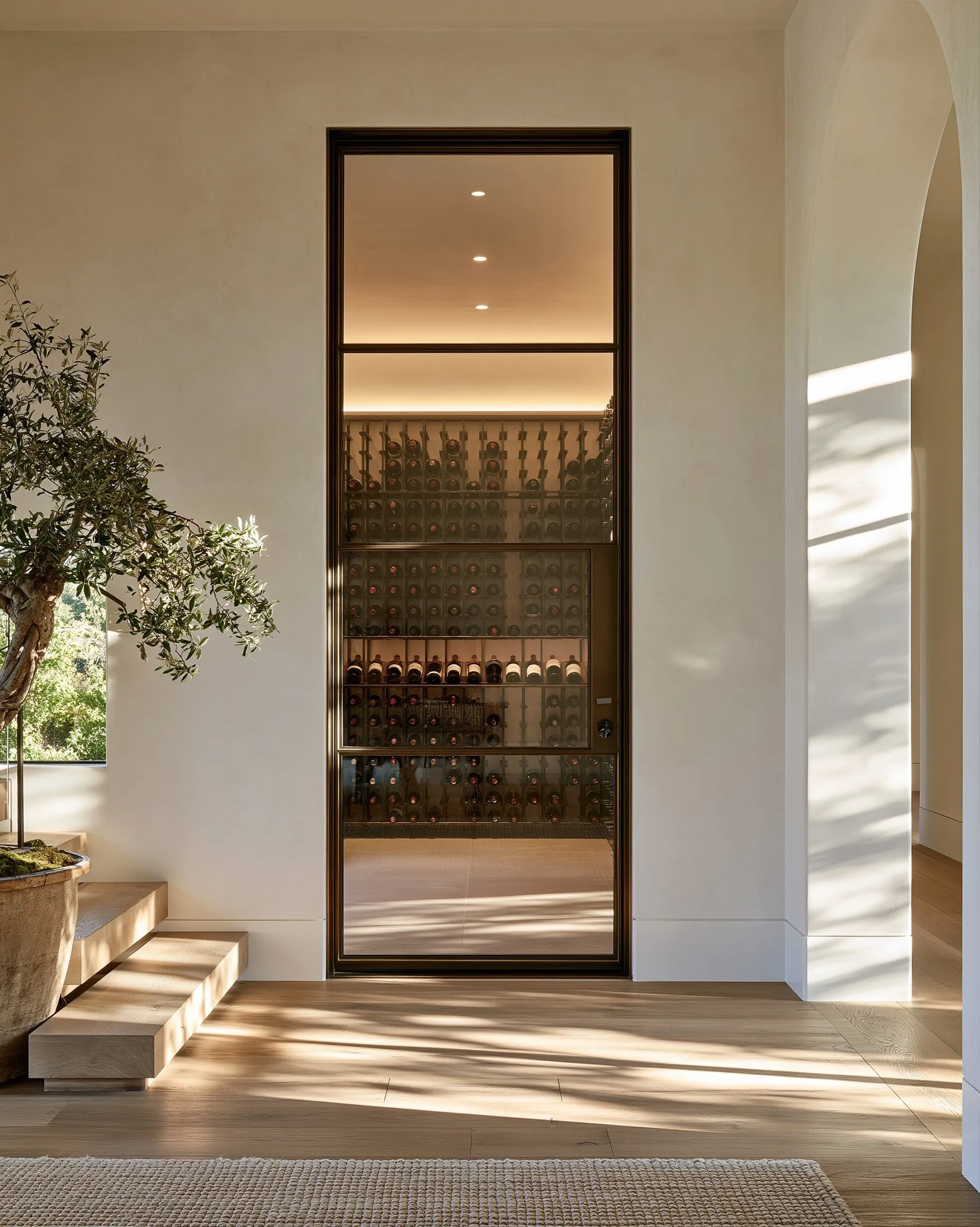
Tall dark-framed glass door into a lit wine room, set in a pale plaster hallway

Cellar doors and glass fronts

A standard door can be the weakest panel in the shell. A solid-core door rates only around R-3 against R-15 for a 2-inch urethane-filled metal door, so cellar doors are exterior grade, weatherstripped on every side and fitted with a bottom sweep. Glass doors use insulated double panes in a tight frame.

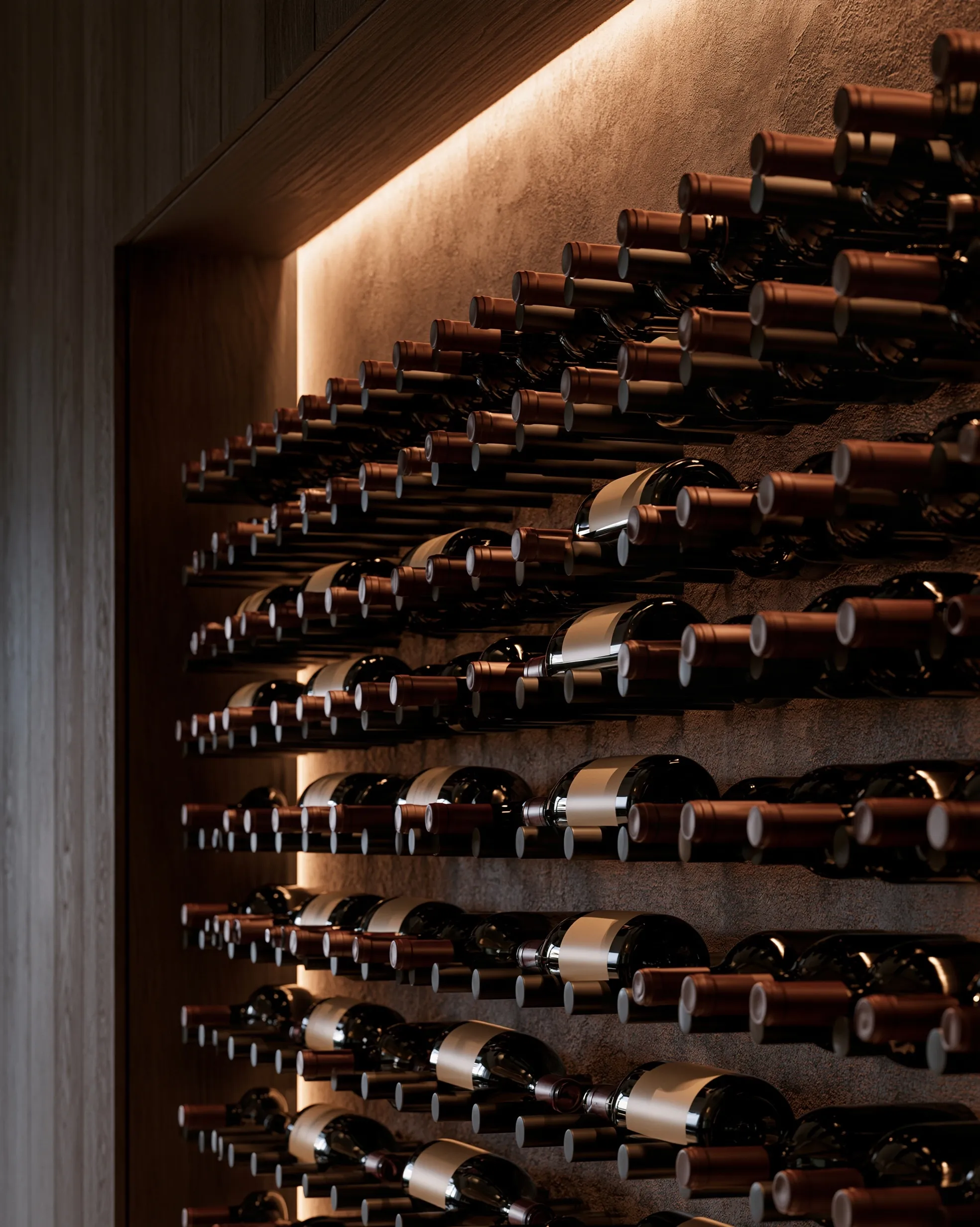
Bottles held on black metal pegs against a textured plaster wall, washed by a concealed LED strip

Cellar lighting

Light damages wine, especially whites and sparkling wines in clear bottles. We plan LED strips with timers or motion sensors and leave out recessed cans, which manufacturers warn let warm air leak into the cellar. Warm amber tones are kinder to wine than cool white.

From first visit to first bottle: building a custom wine cellar

Space and moisture check

We walk the candidate room and the spaces on every side of it, note where warm exhaust could be sent, and check foundation walls and floors for any trace of water.

Layout and racking plan

From the collection’s size, its bottle shapes and how much of it you want on show, we draw the racking, decide where glass and the door sit, and place the lights.

Framing, insulation and vapor control

Walls and ceiling are framed and insulated, vapor control goes on continuously, and every penetration is sealed before anything is closed in.

Cooling, circuit and drain

With the shell defined, we calculate its heat gain, pick the cooling equipment to match, and run its own circuit and a condensate line.

Finish and start-up

Racking, glass, door and lights go in. At start-up a new unit can run almost nonstop while it pulls the room down, which CellarPro says is not uncommon.

What a wine cellar has to control

Temperature first, and steadiness above all. Purdue Extension puts long-term storage between 50°F and 60°F, calls about 55°F traditional, and warns that warmth speeds aging while swings work at corks and let air in. Humidity is the second dial: Building Science Corporation suggests 70% at 55°F, insurer Chubb uses 60% plus or minus 10, and labels can be damaged above roughly 70%.

Darkness and calm finish the list. Cork-finished bottles rest on their sides, light is kept low and UV-free, and the evidence on vibration is limited, though strong vibration may disturb sediment in older bottles.

Wine cellars in Bellevue’s climate

NOAA’s 1991–2020 normals for Sand Point, the nearest full station, just across Lake Washington, give August an average high of 77°F and only about two days a year at 90°F or above. A Bellevue cellar’s cooling size therefore depends more on the house around it, its glass and the tightness of its shell than on summer heat outdoors.

Then there is winter. Sea-Tac’s January normals put the mean dew point near 36°F and mean air temperature around 42°F, so outdoor air stays humid through the winter months. Building Science Corporation points out that moisture moves inward through a cellar wall in summer and outward in winter, so we choose the vapor approach for each wall instead of reaching for plastic sheeting by habit.

Wine cellar construction around Bellevue

Bellevue Wine Cellars builds custom wine cellars and wine rooms throughout Bellevue and in Clyde Hill, Medina, Yarrow Point, Hunts Point, Redmond, Mercer Island, Sammamish, Newcastle and Issaquah. Woodinville’s wine country sits just under ten miles north of central Bellevue in a straight line.

Frequently asked questions

What temperature and humidity should a wine cellar hold?

Wine Spectator calls 55°F the often-cited ideal; Purdue’s long-term range is 50°F to 60°F, and steadiness matters as much as the number. For humidity, the sources we use overlap between 50% and 70%. Wine Spectator calls up to 80% safe, while Building Science Corporation flags label damage above about 70%.

Does every wine cellar need a cooling unit?

Only if the space drifts. A room that stays near cellar temperature year-round can work passively, but a room inside a heated house can sit well above 55°F in winter and warm further in summer, and Purdue’s guidance assumes only a few degrees of swing. For long-term storage, an insulated room with dedicated cooling is the dependable answer.

What affects the cost of a custom wine cellar?

Room size, how much of it is glass, the cooling type (through-wall, ducted or split), the racking material and layout, the door, lighting and finishes, and how much framing, electrical and drain work the space needs. We price after seeing the space rather than quoting a per-bottle figure.

Is a wine cellar different from a wine fridge?

Yes. Wine Spectator defines a cellar as a room or cabinet built for aging, with temperature held steady near 55°F, humidity controlled and light and vibration kept out. Its advice on the kitchen refrigerator is to use it for a couple of months at most, since it runs colder and drier than wine wants, and it notes that some wine coolers may be meant for serving temperature.

Do I need a permit for a wine cellar in Bellevue?

It depends on the scope. The City of Bellevue requires permits for interior remodels that create new walls or convert a basement to living space, for adding or moving circuits, and gives an air conditioner as an example needing both electrical and mechanical permits. Bellevue issues its own electrical permits; Medina, Clyde Hill, Newcastle and Issaquah are not on Washington L&I’s list of cities that do, so electrical permits there come from L&I. We confirm the cooling unit’s treatment with Bellevue Development Services for each job.

Can I build a wine cellar without a basement?

Yes. Across the Seattle metro, about a quarter of single-family homes have a full or partial basement and roughly half sit over a crawl space. A main-floor glass room, a closet, the space under a stair or a wine wall all work when the shell and cooling are planned properly.

Request a wine cellar quote

A few lines are enough to start: which floor of the house, about how big the space is, the size of the collection today and where you expect it to go, and the street address in Bellevue or nearby. We'll get back to you soon with an estimate or any questions we have. Estimates are free and there's no obligation.

Call (425) 699-8428

Call (425) 699-8428