Bellevue Wine Cellars · Services

Closet Wine Cellar Conversions in Bellevue

Bellevue Wine Cellars turns ordinary closets in Bellevue into cooled wine storage. Out goes the hollow interior door, replaced by an exterior-grade insulated door with weatherstripping all around; in go insulation, vapor control and sealed trim and outlets, then racking from the back wall forward. The last decision is where the cooling unit will send its heat.

Closet conversions are a practical route in homes without a basement, and we take them on in Bellevue and in Clyde Hill, Medina, Yarrow Point, Hunts Point and Redmond.

Request a closet conversion quote

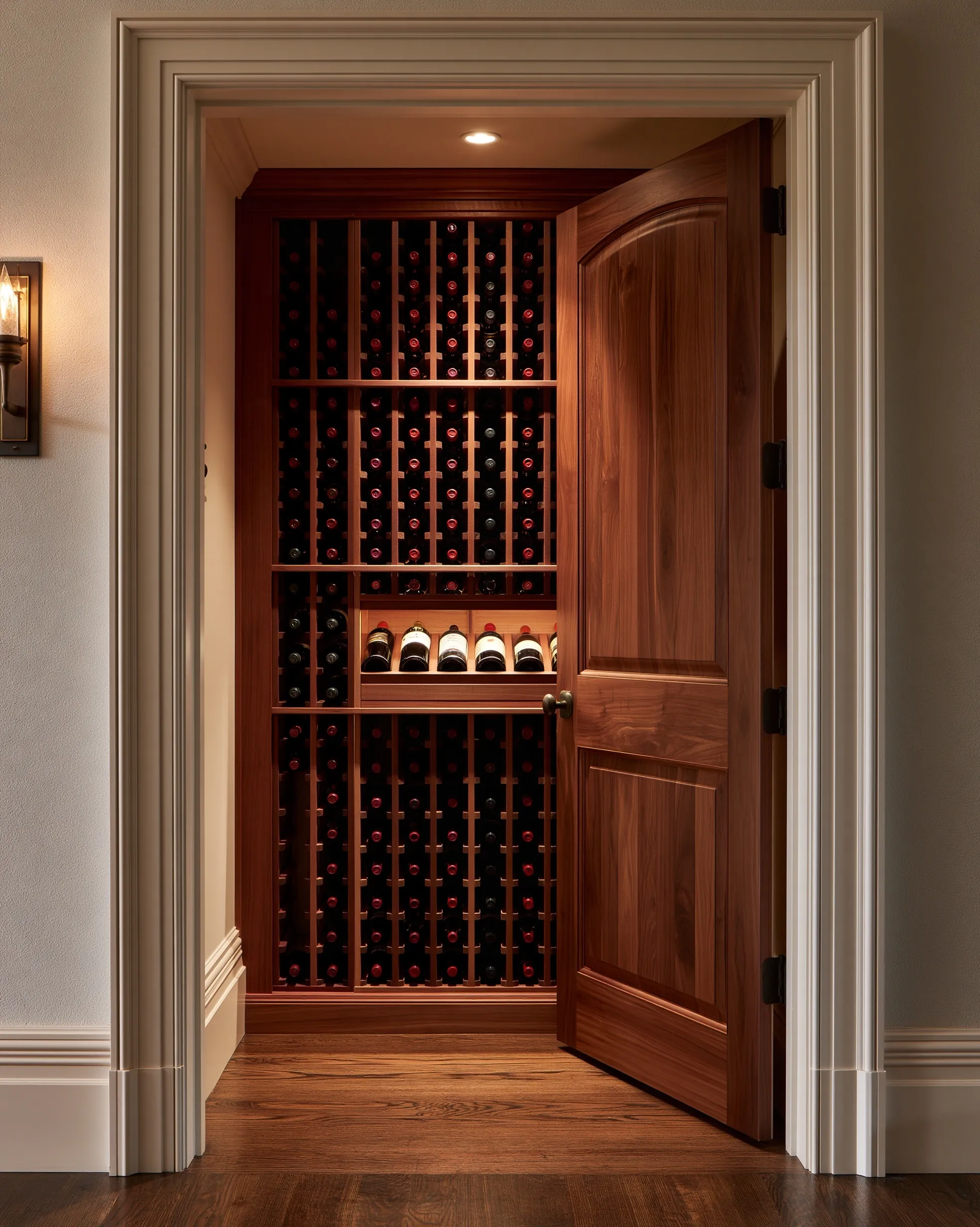
Reach-in closet lined with reddish wood bottle racks behind an open raised-panel wood door

Closet wine cellar options

Reach-in closet conversions

A shallow coat or linen closet becomes floor-to-ceiling racking behind a new door. A hollow-core door rates about R-2, so the door is replaced with an exterior-grade, weatherstripped unit with a bottom sweep, or with insulated glass.

Walk-in closet wine rooms

A walk-in closet has room for racks on three walls. It is reframed if needed, insulated, wrapped in continuous vapor control and sealed at every switch, outlet and joint.

Pantry and spare-room conversions

A pantry or box room gets the same treatment as a closet: insulation, vapor control and sealing. Existing paper-faced drywall is a mold concern in humid cellar air, so we decide whether it stays.

Cooling a closet cellar

Mount a through-wall unit in a closet and its hot side discharges into whatever room is behind it. CellarPro wants that room to have at least the cellar’s volume; WhisperKOOL wants it no warmer than 85°F; Breezaire rules out closets, unventilated laundry rooms and garages as exhaust spaces. If the closet backs onto none of the right kind of room, ducted or split equipment takes the heat elsewhere.

Passive closets

A closet without cooling follows the house. That can be acceptable for bottles opened within months, but Wine Spectator treats storage above 70°F as too warm for aging and Purdue warns that swings stress corks, so a passive closet is short-term storage rather than a cellar.

Closet conversions in Bellevue homes

Bellevue’s mild summers help here: Sand Point normals show only about two days a year at 90°F or above, so a large, ventilated room beside the closet has a better chance of staying under the 85°F exhaust limit than in hotter places. An upstairs room in a heat wave still needs checking, and a closet beside another closet is still not an option.

Inside city limits, Bellevue asks for a permit when a remodel creates new walls or turns a basement into living space, and when circuits are added or moved; the city also issues its own electrical permits rather than leaving them to Washington L&I. A conversion that adds a circuit for the cooling unit needs an electrical permit; we confirm the rest with Bellevue Development Services.
Frequently asked questions

Does a closet wine cellar need its own cooling unit?

For long-term storage, yes. Without it the closet tracks house temperature, which is fine only for near-term bottles.

Where does the cooling unit vent?

Either into an adjoining room that meets the size and temperature limits above, or, when there is no such room, away through ducting or a split system.

What has to change besides the racking?

Four things beyond the racks: a proper cellar door, insulation, vapor control and thorough air sealing. Together they determine whether a small cooling unit can keep pace.

Request a closet conversion quote

Which closet is it (coat, linen, walk-in or pantry), and what sits behind its walls: a bedroom, a hallway, the garage? Add the address and we can start sorting out where the cooling could vent. We'll get back to you soon with an estimate or any questions we have. Estimates are free and there's no obligation.

Call (425) 699-8428

Call (425) 699-8428