Bellevue Wine Cellars · Services

Basement Wine Cellars in Bellevue

Bellevue Wine Cellars turns basements and lower-level rooms in Bellevue into wine cellars, starting with the first question for any lower-level cellar: whether the foundation stays dry. From there the room is framed off the concrete, insulated and vapor-controlled, sealed at every penetration and fitted with cooling sized to what the earth and the house add.

A lower floor is only one option, so we plan basement cellars alongside main-floor alternatives, in Bellevue and in Clyde Hill, Medina, Yarrow Point, Hunts Point and Redmond.

Request a basement wine cellar quote

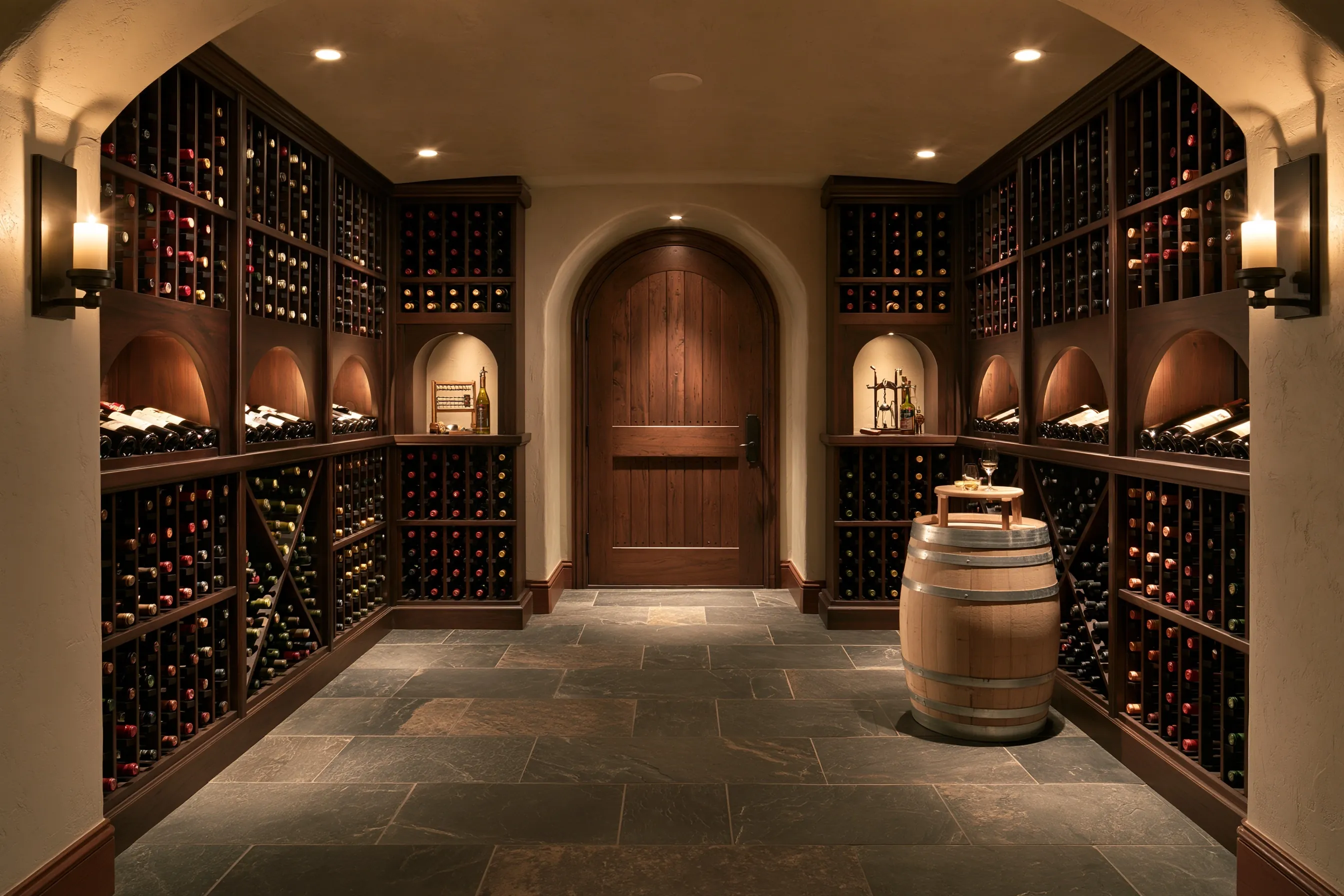
Lower-level walk-in cellar with arched niches, dark wood racks, a slate floor, an oak barrel and an arched plank door

Basement wine cellar options

Unfinished basement rooms

Bare concrete is not insulation or a moisture barrier. Any water intrusion is dealt with before framing, studs stand at least an inch off foundation walls for air circulation, and a concrete floor without a vapor barrier under it gets a waterproof sealer before wood or carpet. Its heat load is also counted in sizing.

Converting a finished lower-level room

An existing rec room or guest room may have paper-faced drywall, which Building Science Corporation steers away from in cellars, favoring mold-resistant materials such as rock and wood. We look at what can stay, what comes out, and how the new vapor control will tie into the existing walls without trapping moisture.

Daylight and partial basements

Where a lower floor steps out of a slope, some walls are below grade and some face open air. The exterior-facing walls carry more heat, so they get higher insulation, R-30 in one manufacturer’s guide, and glass on that side is avoided or upgraded.

Below-stair pockets and crawl-space exhaust

A basement stair can leave a ready-made pocket for a smaller cellar, and its slope and exhaust questions are covered on our under-stair page. Crawl spaces are a different matter: one cooling maker lists them among places not to exhaust warm air.

Is a basement cool enough without cooling?

A basement can run cool without staying steady. Purdue Extension’s storage advice assumes temperature held within about 2°F to 3°F, and a basement that drifts with the furnace in winter and the house in summer will not stay that tight. A passive basement can suit near-term bottles; for long aging, an insulated room with dedicated cooling is the reliable route.

Moisture and mold

Cellar air runs humid by design, so the materials have to tolerate it. Rock, solid wood and mold-resistant boards suit the room; paper-faced gypsum and engineered lumber do not. Building Science Corporation also warns against cleaning cellars with bleach, because chlorine can lead to cork taint (TCA).

Vapor control is where opinions split. Cooling manufacturers specify plastic sheeting on the warm side of the insulation; building scientists point out that the warm side flips between summer and winter and prefer closed-cell spray foam or rigid foam that slows vapor in both directions. We pick the assembly per wall, below grade and above.

Permits for finishing a basement

The City of Bellevue lists converting a basement to living area as remodel work that needs a permit, along with creating new walls and adding or moving electrical circuits. A basement cellar can touch all three. The city issues its own electrical permits, and its permit staff note a single installation can need more than one permit; we confirm with Bellevue Development Services how the cooling unit is handled.

Basements, crawl spaces and lower floors in Bellevue

Across the Seattle metro, basements are the exception. In the Census Bureau’s 2023 American Housing Survey for the metro, about 24.6% of single-family homes had a full or partial basement, 51.6% sat over a crawl space and 22.8% on a slab; no Bellevue-only figure exists. Where a house has a lower floor, it may be fully below grade or a daylight level on a slope; where it has none, the same cellar can go into a main-floor room, a closet or under a stair.

Frequently asked questions

Is my basement naturally cold enough?

Probably not steady enough. Even a cool basement moves with the seasons and the furnace, and Purdue’s guidance assumes only a few degrees of swing; dedicated cooling is the dependable route for long-term storage.

Do I need a permit to build a basement wine cellar?

In Bellevue, generally yes: the city requires permits for basement-to-living-space conversions, new walls and new or moved circuits. We confirm the specifics for your address.

What about a damp basement?

Fix the water first. Then the framing stands off the foundation, the slab is sealed if there is no vapor barrier under it, and materials are chosen to resist mold.

Request a basement wine cellar quote

Describe the lower level as it is today (raw concrete, framed or fully finished), any past seepage or damp smell, and the street address. We'll get back to you soon with an estimate or any questions we have. Estimates are free and there's no obligation.

Call (425) 699-8428

Call (425) 699-8428