Bellevue Wine Cellars · Services

Wine Cellar Cooling Systems in Bellevue

Bellevue Wine Cellars chooses and installs the refrigeration behind Bellevue wine cellars, from one-piece through-wall units to ducted units and split or ducted-split systems, in new builds or as a swap for an old unit. Purpose-built cellar equipment such as CellarPro’s cools gently without pulling moisture out of the air, which comfort air conditioning is not designed to do; the right type comes down to where the heat can be sent.

We size and install cellar cooling in Bellevue and in Clyde Hill, Medina, Yarrow Point, Hunts Point and Redmond. We supply and install equipment as part of a build or replacement; we do not offer repair service.

Request a cooling system quote

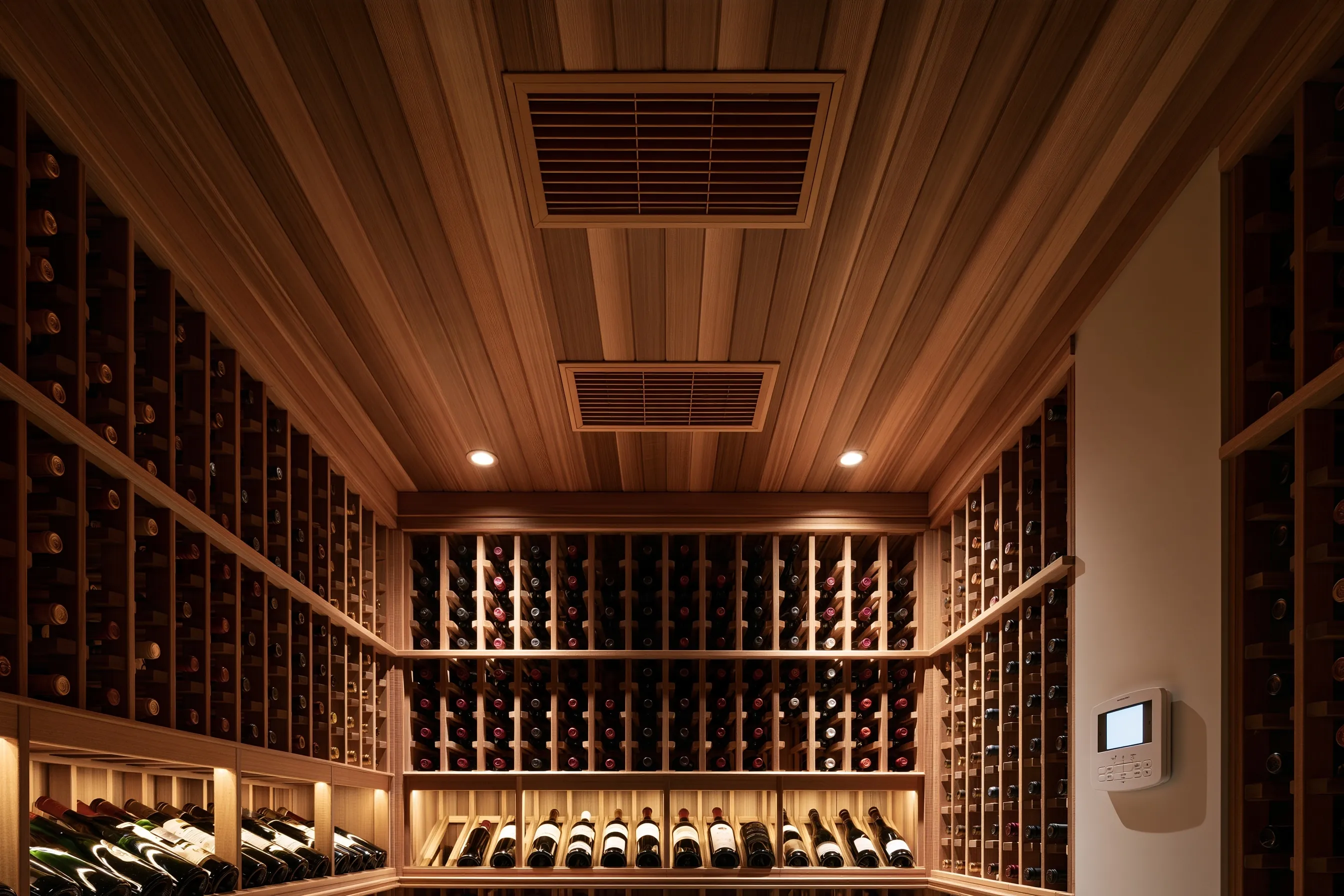
Wood-lined walk-in cellar with two ceiling grilles for ducted cooling, racking on three walls and a wall-mounted controller

Wine cellar cooling system options

Self-contained through-wall units

One box set into the cellar wall is the most straightforward option. It needs an exhaust room of at least the cellar’s volume (CellarPro) that stays below 85°F (WhisperKOOL) for the unit to hold 55°F. Its warm side is noisy, so a big utility or recreation room suits it far better than a closet.

Ducted self-contained units

Ducted self-contained equipment is tucked into an attic or a utility room and breathes for the cellar through a pair of ducts, so the cellar itself stays quiet. On WhisperKOOL’s figures, its Phantom keeps the cellar at 55°F while the space around the unit stays anywhere from 42°F to 110°F.

Split systems

Think of a split as two halves joined by copper. Inside the cellar is just the evaporator; the condensing half, the noisy and hot one, goes outside or into a ventilated room some distance away, which also lets it tolerate warmer surroundings. WhisperKOOL and Wine Guardian both insist on a qualified refrigeration technician for installation, and EPA Section 608 certification governs the refrigerant connections.

Ducted split systems

A ducted split moves every mechanical part out of the cellar: the fan coil sits in a nearby space, the condensing unit outdoors or in a remote room, and only two grilles appear in the ceiling or wall. Wine Guardian singles out this layout for glazed rooms that have no good place to dump condenser heat.

Replacing or upgrading an existing unit

A unit that runs constantly or drips may be undersized, or the shell may be leaking. We check door seals, vapor control and heat load before sizing a replacement, since a bigger unit cannot fix an open envelope.

Sizing and heat load

Sizing is a balance sheet: what the unit can remove at 55°F must beat what the room gains. Published tables only hold for fully insulated, vapor-sealed rooms, and CellarPro’s are built on an 85°F peak outside the cellar. Glass, walls facing outdoors, a bare slab or a weak vapor barrier all push the real load past the tables and call for a custom calculation, and WhisperKOOL will not warrant an undersized unit. After start-up, CellarPro says its units may run nonstop for as long as a week, then settle to running up to 75% of the time.

Why not a home AC or mini-split

Comfort systems are built for about 72°F and dry air. Wine Guardian says mini-splits rarely reach 55°F to 58°F and aim for humidity no higher than 50%, and Wine Spectator notes window units typically bottom out near 62°F while drying air to around 35%, which can crack or crumble corks. Wine Guardian sells cellar equipment, so weigh its claim accordingly, but both points line up with how comfort equipment is designed.

Electrical, drains and permits

Circuit requirements vary by maker: CellarPro calls for a dedicated 15-amp circuit for its 1800 series, while WhisperKOOL asks for a dedicated 20-amp circuit plus a surge protector for the Phantom. Ducted and split evaporators need a condensate line, sometimes with a pump, and WhisperKOOL makes the drain mandatory on its ducted and ceiling-mount models. The electrician sets circuit protection by the manufacturer’s instructions and current code.

Inside city limits, Bellevue asks for a permit when a remodel creates new walls or turns a basement into living space, and when circuits are added or moved; the city also issues its own electrical permits rather than leaving them to Washington L&I. Bellevue’s own example of an air conditioner needing both electrical and mechanical permits is the closest stated case, and we confirm with Bellevue Development Services how a cellar unit is treated.
Cooling loads in Bellevue

Sand Point normals record about 211 cooling degree days a year and roughly two days at 90°F or above. A Bellevue cellar’s cooling size is driven mostly by glass, exterior walls and the tightness of the shell. Damp winters keep vapor control and a working drain on the list, because a leaky shell shows up as water in the condensate line.

Frequently asked questions

Which type of cooling system do I need?

Work backward from the exhaust. If a big, cool room adjoins the cellar, a through-wall unit is the simple answer. If nothing nearby can take the heat, ducted equipment in an attic or utility room fits. Glass rooms, and cellars where silence matters, are where splits and ducted splits earn their extra cost.

Can I use a regular mini-split?

A comfort mini-split is aimed at warmer setpoints and drier air, so it is a poor stand-in for cellar equipment.

Does a cooling unit need its own circuit?

For the units cited on this page, yes: CellarPro and WhisperKOOL each call for a dedicated circuit, and the electrician sizes and protects it according to those instructions and code.

Request a cooling system quote

For cooling work, the useful facts are the cellar’s dimensions, any glazing, the make of an existing unit if there is one, and the rooms on each side. Add the address. We'll get back to you soon with an estimate or any questions we have. Estimates are free and there's no obligation.

Call (425) 699-8428

Call (425) 699-8428